“For anyone who dreams of making movies or who is just starting out, the situation at this moment is brutal and inhospitable to art.”
Martin Scorsese
This is not the result of a shortage of creativity. As Joseph Beuys stated, “Every human being is an artist.” Instead, it is the consequence of an increasing inability to share creativity with audiences. This stems from the misevaluation of the ‘suits’ (the middlemen: producers, dealers, agents, editors and impresarios) and a decline in their ability to manage the tension between the search for creativity, the exploring of the unknown, and the desire for familiarity. As a result, we now live in a world Adam Mastroianni and Jason Farago describe as the “least innovative, least transformative, least pioneering century for culture since the invention of the printing press.”
This article explores both why the ‘suits’ are misevaluated, and why bad ‘suits’ smother creativity; sacrificing new artistic ideas for reliable, repetitive, low-risk ideas. This method is becoming increasingly attractive with the advancement of digital technologies, the rise of streaming and the growing role of AI. We will examine these trends and their consequences, looking at Disney and the Star Wars franchise, as well as Francis Ford Coppola’s Zoetrope Studios. To address these challenges, the article defines the characteristics of a new generation of ‘suits’ with the skills to revitalise contemporary artistic creativity. It suggests the film, TV, music and art industries need to develop a more flexible portfolio approach to managing creativity, as used in the horror film industry. Finally, the article proposes updating art and business degree courses with programmes on managing creativity using an MBA-type case study approach.
In the intense need to celebrate the ‘genius’ of creatives: artists, filmmakers, musicians and writers, there is often undervaluation of the people responsible for bringing creativity to audiences. These middlemen, or the ‘suits’, can play a key role in identifying creative talent, nurturing their ideas, financing their development and then positioning their work to audiences. Each of these steps is complicated and the relationship between the creatives and the ‘suits’ is frequently characterised by tension. Back in 1884, Claude Monet wrote an exasperated letter on artistic freedom to his dealer Paul Durand-Ruel, stating, “but as to polish – or rather slickness, because that’s what the public wants…I’ll never agree to it.”
This tension is inevitable with creatives pushing boundaries, audiences seeking a degree of familiarity and the ‘suits’ in the middle attempting to moderate these perspectives and interactions. Unfortunately, the ‘suits’ are often looked down upon in this three-way relationship and positioned as a necessary evil, the money-men. Even worse, they can be seen as the natural enemy of creativity. Pink Floyd’s song “Have a Cigar” from the album Wish You Were Here, satirises their greed, lack of imagination, and detachment in the words, “Oh, by the way, which one’s Pink?” Their flippant misunderstanding inadvertently reveals the destruction done by a producer that doesn’t understand their artist. The producer is asking an impossible question; none of them are ‘Pink’, and therefore none of them really matter. Only the marketable iconography the band produces is valuable, not the lives and work behind it. The devastation of bad ‘suits’ means that the flip side, a good ‘suits’ vital work and synergistic relationship with artists, has been frequently underestimated. Even in Pink Floyd’s case, producers and management played a critical role in the band’s success. This lack of recognition limits the ability of the ‘suits’ to manage the flow of creativity to audiences.
This problem has been exacerbated by the growth of digitisation, streaming and AI and the increased emphasis on predictability and repetition. Digitisation simplifies the process of copying while streaming supplies abundant, specific information about what audiences like. Using this information, ‘suits’ can sculpt work around proven beats in a highly formulaic way. The downside is that these works rapidly become repetitive and boring, and audiences check out. While the internet has enabled artists to have a direct line to their audiences, the results have not been entirely beneficial. Audiences are now often overloaded with too much ‘creative content’. As a result, the need for ‘suits’ to act as a filter and to channel information between creators and the audiences remains relevant. Some would argue that algorithms and AI now fulfil this role and that they are the new ‘suits.’ However, these new technologies are not a substitute, as they can reinforce predictability and repetition by using Large Language Models to extrapolate past trends and algorithms to generate ‘echo chambers.’
The consequences of the lack of effective ‘suits’ can be seen in the film industry with the decline of Disney’s Star Wars franchise and the failure of Zoetrope Studios. Disney has throughout its history struggled to find a balanced approach to maintaining creative output and commercial performance. As a corporation trying to reduce uncertainty, they have been liable to fall into whirlpools of repetitive and predictable films. Star Wars has declined in popularity in recent years, as audiences increasingly complain about unimaginative, ‘safe’ stories, flat filmmaking and repeated invocation of iconic imagery (the Jedi mind trick, first introduced with the line, “These aren’t the droids you’re looking for,” is repeated in six of the subsequent movies). Although audiences initially respond to re-seeing their favourite scenes, they have limited patience, and eventually grow tired of the same things being fed back to them. The repetitive, predictable model has benefits but is cursed with a short half-life.
While creativity struggles to flourish under too much restrictive control and predictability, removing the ‘suits’ altogether can also be destructive. In 1980 Francis Ford Coppola opened Zoetrope Studios, a totally independent production house. He had just finished making three of the most acclaimed films of all time, Apocalypse Now and The Godfather I and II, but felt increasingly constrained by the interference of the ‘suits’. His aim with Zoetrope Studios was to create a liberating environment. However, while working at the studio was stimulating, its potential was weakened by the absence of ‘suits.’ ‘Suits’ can sharpen creative work; technical and budgetary constraints push the artist to be focused and specific. Without them, there is no moderator to channel the creative energy. Furthermore, they understand the industry as a whole; they know what audiences are looking for. Critically, they provide access to the marketplace. As a result, Zoetrope Studios, with films like One from the Heart, which made less than $700,000 off a $26 million budget, went bankrupt after only three years.
There is a need for a system that supports all three sides. The artist needs freedom and a nurturing environment, audiences want to be challenged within boundaries, and the ‘suits’ require predictability and the opportunity to influence and support creatives. Importantly, each party needs to recognise that they are dependent on each other. The creative’s work, without the ‘suit’, is never seen. A great work rots in an attic, forgotten. The ‘suit’ without the creatives’ challenge can default into following audiences into predictable, pandering works, which result in declining interest. Lacking the discipline provided by the ‘suits’, the artist can become self-indulgent, overblown and fail to recognise what audiences are looking for. The net result, audiences fail to have the opportunity to experience the revelation of genuinely creative works of art.
In looking for solutions to these challenges, the Impressionist and Post-Impressionist period, between 1870 and 1914, provides important insights. These years were characterised by revolutionary forms of artistic representation, conservative audiences, changing art markets and the new technologies of photography and film. Analysis of Paul Durand-Ruel, with Impressionism and Theo and Jo Van Gogh-Bonger (Vincent’s brother and sister-in-law) on his behalf, reveals role model behaviour of effective ‘suits’ in influencing the painters, educating audiences and developing markets for creative and challenging artworks.
Paul Durand-Ruel played a critical role in the emergence of Impressionism. He advised Monet, Renoir and Pissarro on what and how to paint (largely based on market feedback). He helped shape the painters’ narratives, emphasising continuity with the Barbizon school and organised art critics and prepared catalogues to support their exhibitions and auctions. He built up demand and managed prices by buying up stock and controlling supply. During the challenging and difficult times before Impressionism was widely accepted, he provided many of the painters in the group with both financial and emotional support.
The roles of the ‘suit’ are exemplified by Theo and Jo van Gogh-Bonger, who influenced Vincent’s artistic work, established his reputation and developed the market for his paintings. Theo was artistically influential. He challenged Vincent’s use of dark palettes, introduced him to the Impressionist community in Paris, which in turn led to a “series of color studies in painting… trying to render intense color and not a gray harmony.” Jo organised and developed art dealers, collectors, curators and art historians to promote Van Gogh. Assiduously, she built the idea of a tortured genius with a unique and intense artistic perspective. Commercially, she established sales channels, organised exhibitions, set prices and controlled supply. Analysis of the variation of Van Gogh’s acceptance in different countries, particularly between Germany and the UK, suggests that without their support, Vincent’s creativity would not have been so widely recognised.
Paul Durand-Ruel and Theo and Jo van Gogh-Bonger provide a template to define the role and to raise the status of a new generation of ‘suits.’
In particular, there is a need to select, train and support people who:
- Understand the importance of pivoting between two conflicting ideas, between uncertainty and familiarity
- Expose themselves to new forms of artistic creativity
- Appreciate the need for insight into audiences
- Filter, blend and edit creative ideas
- Decouple from market research-driven artistic design, from ‘giving people what they think they want’ and taking risks and pushing boundaries
- Recognise the relationships between the creators and their work and the resulting narratives
- Understand the role of timing and shaping of audience expectations
- Deliver the fundamentals: administration, cataloguing and logistics
- Retain a love of their medium and the work
This will require a reassessment of recruitment criteria and redesign of mentoring and intern schemes in the creative industries, including film studios, galleries, auction houses and the theatre. Different standards for promotion will need to be developed. Most importantly, there needs to be greater recognition of the important role that ‘suits’ have in the creative process.
In addition, reinforcing entrepreneurialism in the creative industries will also be necessary. The approach used to develop horror movies, with their low-cost productions, original scripts, new directors and an economic model where only a small number of films are disproportionately successful, could be adopted in other sectors.
Developing more case studies in managing the relationship between creatives and audiences for degrees in art and business would also be valuable. This could include analysis of creative organisations including Disney, Pixar, Hauser and Wirth, Christie’s, MOMA, Asylum Records and The National Theatre, as well as the careers of influential ‘suits’. Areas of focus could include identifying artistic talent, nurturing skills, audience assessment, shaping artistic thinking,
creative blending of ideas, developing artistic narratives, logistics, business planning and economics.
The failure to recognise and develop ‘suits’ is a missed opportunity. Focusing on all parts of the creative process, including the position, role and skills of the ‘suits’, would lead to better films, TV shows, music, artworks and theatre. This would have lasting benefits for artists, audiences and the creative industries as a whole.
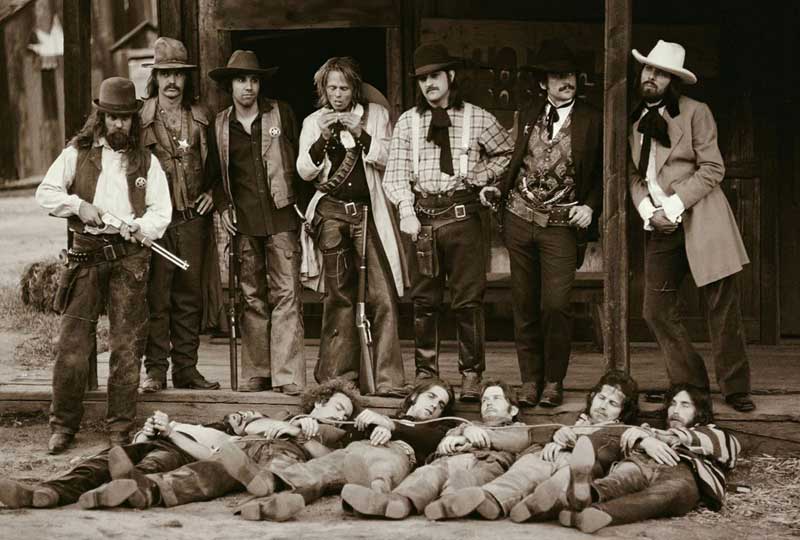
The band’s managers and producer stand over the band members, who lie tied up at the front.


Leave a Reply