“The act of sewing is a process of emotional repair.”
Louise Bourgeois
Sewing, in all its forms: weaving, knitting, crochet and embroidery, has a unique quality and meaning derived from the range of materials used in the structured process of creation. The medium informs the works created, but so does the process of creation. This is particularly clear in textiles because the marks of labour are so physically apparent. These characteristics make ‘sewing’, and other (handmade) textile art forms especially valuable as mnemonic objects that carry ideas, identities, and histories.
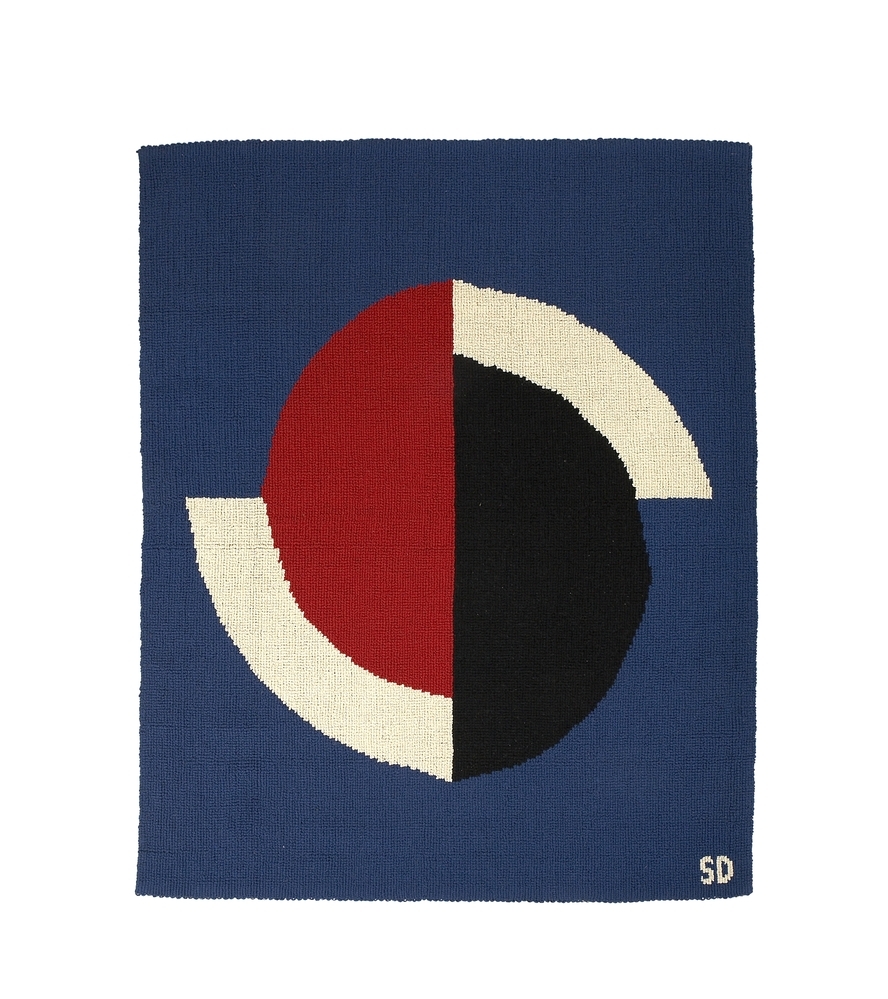
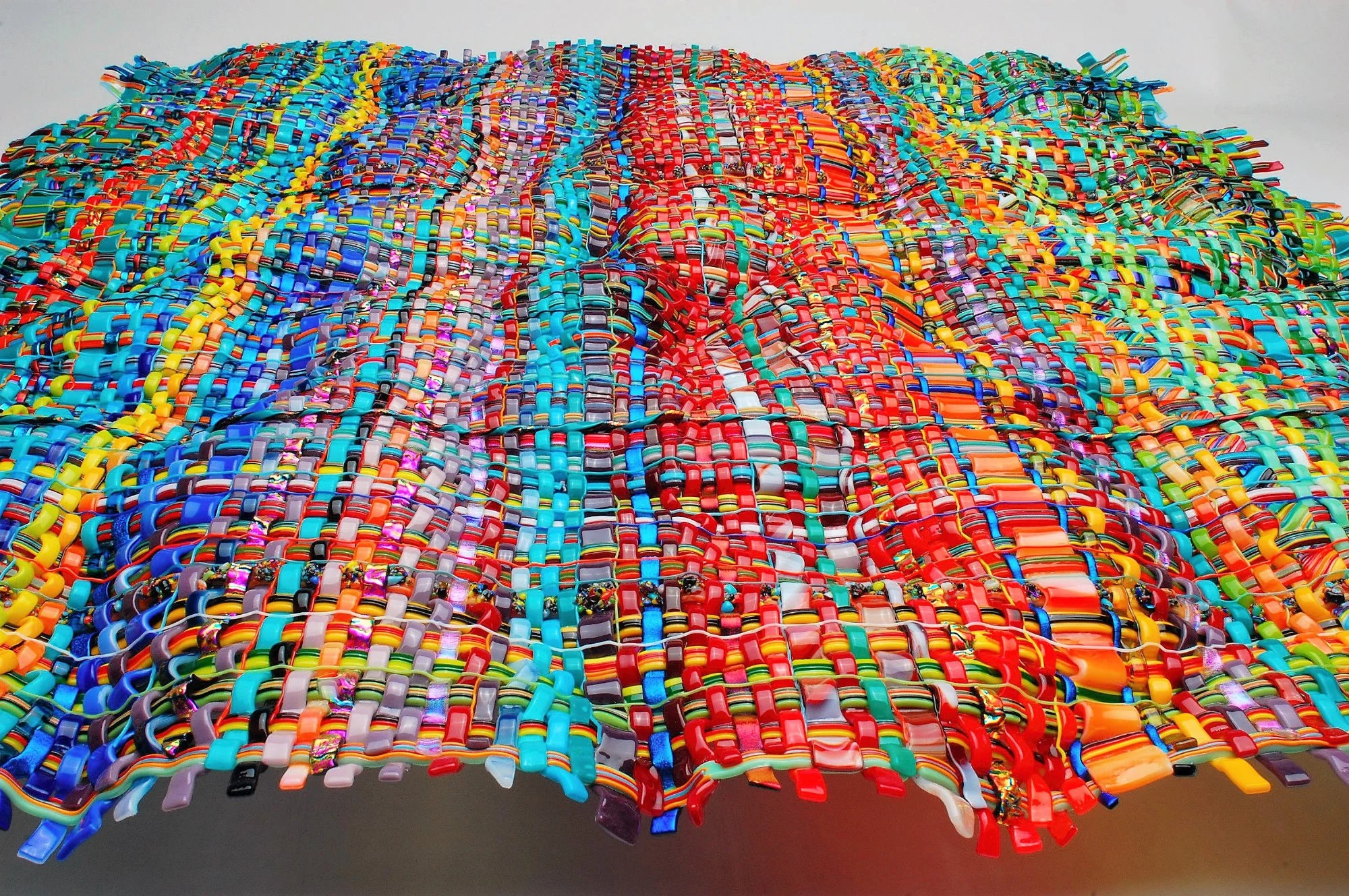
The medium of textile art informs its meaning in a way distinct from other art forms. Briony Fer makes this clear when she says, ‘weaving is not painting. A wallhanging is not a picture’. Anni Albers describes the importance of the materials, ‘being creative is not so much the desire to do something as the listening to that which wants to be done: the dictation of the materials’. Materiality in textiles is the result of the combination of colour and tactile physicality: its texture when touched and the way it folds when seen. These can be configured in infinite different ways, and to different effects, from intricate tapestries to simple wall hangings, to ornate carpets and translucent floating mobiles. The distinctiveness of textile art flows from the breadth of its materiality but also, paradoxically, from the limitations of the medium, which, as Albers noted, acted ‘like a railing’: both a cage and a guide. Kelsey Worth Solomons comments that, for Albers, ‘limitations may act as directives … Great freedom can be a hindrance because of the bewildering choices it leaves to us, while limitations, when approached open-mindedly, can spur the imagination to make the best use of them and possibly overcome them’. Thus, the repetition of action and the horizontal and vertical restrictions inherent to the medium also drive creativity. But the net effect, as Albers states, is a breadth of freedom and creative potential which, ‘besides surface qualities, such as rough and smooth, dull and shiny, hard and soft, textiles also includes colour, and, as the dominating element, texture which is the result of the construction of weaves’. The freedom of colour and texture in combination with the limitations of a repetitive, ‘railing’ structure and practical considerations make textile art especially suitable for abstraction, and in particular works that explore geometry and shape, as in Anni Albers, Tikal (1958). Fer describes how the textile object, with its fluidity of form and grid design, engages ‘with the relationship between rectilinear and curved surfaces, and how the one does or does not distort or disrupt the other. In the process, flat geometric designs transform into more complex continuous surfaces that exist in the round’. This also means that ‘woven’ art naturally, through movement and use, simulates infinite distortions of the same shapes, seen from different angles. Gego’s ‘Line as Object’ (2014) represents this fluidity in its ultimate form. As Fer says, the ‘slippage between several different possible orientations, where art penetrates everyday life in multiple ways, demonstrates its pliability’. This defines sewing as a three-dimensional object. Textile art has a topology to it; the interconnected movements of the threads are curled over and around each other, creating tiny ridges and gulfs throughout. This effect is compounded through the use of varied materials. Think of the tactile difference between silk string and thick twine and how this affects meaning. Silk is fine and sinuous and associated with grace and luxury, whereas twine might evoke more rustic, practical feelings. Albers evokes this tactile, sensory experience of material, describing the difference between ‘something that is warm to the touch, quite possibly color, the soft play of folds and the luster of fuzz of fibers in contrast to flat, hard and cool surfaces’. Both the physical qualities and the situations in which we tend to encounter it affect how we view the medium and thus experience the art.
As Bourgeois makes clear, sewing is an ‘act’, a ‘process’. It is a thing that should not, or cannot, be separated from the process of its creation. In practice, hanging a textile work on the wall hides the ‘back side’, the side with the loose ends of threads and ugly knots, and thus refuses to acknowledge the heart of the work. Textile art is unique because it cannot hide the effort that went into creating it; it is an unimpeachable part of the work, visible in each stitch. Hiding this ‘back side’ cuts the work in half; it rejects the dimensionality of the medium and obscures the energy and attention of its creation. The ‘act of sewing’ is unique in lots of ways. There are physical and practical qualities to this medium that create beauty and meaning. This is especially true with textiles because of the intricate relationship between object and ‘process’. While the physical qualities of textiles affect meaning, so does the physical process of construction. This is because the ‘act of sewing’ can be characterised by its procedural qualities: held in the repetition of motion, loops, knots and interweaving, which accurately describes the creative movement of the artist’s hand both in a physical and metaphorical sense. These features of the ‘process’ and the restrained, dialectical relationship between them make sewing an act that provides feeling to the stitcher. The feelings are of control, giving, connection and continuity, which explain the ‘emotional repair’ that Bourgeois highlighted. Sewing enables a sense of control, because the process has a unique characteristic: it is governed by the mantra ‘I do, I undo, I redo’. This evokes the repetitive motion of sewing and the inherent transience of the medium. Sewing is a unique form of gift, involving time, effort, as well as material. As the American Sewing Guild suggests, ‘your donation makes a direct impact in another’s life, the benefits to you are just as important. Giving is in our nature and those that do experience a sense of personal satisfaction and feelings of self-worth’. The process of sewing engenders the idea of connection. ‘The prime function of sewing is to join things together.’ In a simple way, this represents unity and connectedness and is why textiles are often used to support and enable cooperation and integration of diverse groups. In particular, Kettle has explored the role of textiles in ‘visualising narratives of displacement and belonging; empowering marginalised communities and individuals; and communicating through the agency of stitch’. Albers, too, recognises the power of textiles, and also identifies this as a cyclical process and continuity. She says textiles have a ‘magic of things not yet found useful’, and asks ‘let threads be articulate again / and find a form for themselves to no other end’. Distinct from other artistic mediums, textiles always remain in a state of creation, even after they are finished. Thread turns into fabric, which is then turned into a different object. A piece of clothing has a new life after it is made; ‘clothing is… an exercise of memory … It makes me explore the past … how did I feel when I wore that’, says Bourgeois. A rug or blanket is similarly used, not ‘put aside’ for consumption. This keeps textiles in a perpetual movement, in process, giving them very strong emotional power that is often associated with family and identity. Consider how woven objects are frequently given to celebrate a birth: a blanket passed down by a grandmother, a knitted outfit for the child; the objects are literalised stand-ins for the emotional interweaving and tribal bonds being offered by the objects. These unique characteristics of sewing and textiles are captured in the story of Penelope in Homer’s ‘Odyssey. At first, she delays her own marriage to her suitors while her husband, Odysseus, is lost at sea. One of her methods of avoidance is to refuse to marry until she has completed weaving a ‘burial shroud’ for her father; each day she sews, and each night she undoes her work. In this story, there is a connection drawn between Penelope’s weaving and her ability to control her situation and her identity. By keeping the object in a state of motion as she does, Penelope stays slippery, out of reach of the men around her. The ‘undo … redo’ of her actions, the slow forward and back, has a wave-like quality, as if she, like her husband, is suspended – both trapped and kept alive by the sea. There is no coincidence that the challenge faced by Odysseus when he finally returns also involves weaving, but in this case, the purpose is to join and reconnect. Penelope has declared that she will only marry the person who can ‘string Odysseus’s bow’. When Odysseus, in disguise, is the only suitor who can do it, it marks his heroic return. This is often characterised as only a test of physical strength or a kind of identification test, as if the bow would remember him, but this overlooks the importance of sewing as a tool that defines identity through action and also as a connective force.
The creative freedom of the material, when combined with the iterative form, gives textiles a further quality; it is a particularly good medium for capturing and relaying ‘memory’. The action of sewing can be used as a memorisation technique. The repetitive motion of looping and linking functions as a mnemonic device, allowing for greater recall, such as in the practice of tying knots in string as physical reminders. A rosary functions in a similar way, where each bead on the string is itself a repeated object and a reminder of the repetition of prayer. Weaving and memory are associated with cultural memory, as well as personal memory. The techniques in the ‘act of sewing’ and the resulting objects are often passed down through groups or families, and are used to communicate the history or identity of the group. This is used for political effect, as physical demonstrations of agency, identity and collective action. Kettle identifies that ‘interrogating textiles’ has a role in shaping identity, politics and society’, as with the ‘Aids Memorial Quilt’, which directly called upon the relationship between textiles, memoriam and activism. Sewing remains a political act, now as it relates to community and the environment.
The colour, materiality and the unique pliable characteristics of textiles, the idea of memory, community and of collective action are embodied in textile arts. The act of creating and experiencing the works gives a sense of freedom and control. Additionally, these qualities make this medium particularly good at storing memory. This is reminiscent of Ursula Le Guin’s essay ‘The Carrier Bag Theory of Fiction’, which entirely reframes the hunter/gatherer divide, the importance of storage, and the role of language and stories to humanity.




 The Archive of Free Thinking
Leave a reply to amcintyre13 Cancel reply