“In the era of welfare capitalism, the enlightened corporation, not the labour union or the state, would spearhead the creation of a more benign industrial society.”
Lizabeth Cohen
In the early twentieth century, Industrial Paternalism, as a form of Welfare Capitalism, emerged as a new method of managing wealth distribution. This was a consequence of the rise of mass production, the growth of large corporations with increasing monopoly power, as well as the counter-reaction from workers and increasing industrial unrest. With the emergence of similar trends today: monopolisation, a widening wealth gap, ease of communication between workers (across both industries and countries), and new, disruptive technologies like AI, there is a need to return to the question faced by the twentieth-century industrialists. What does a company owe its employees and the communities they operate in?
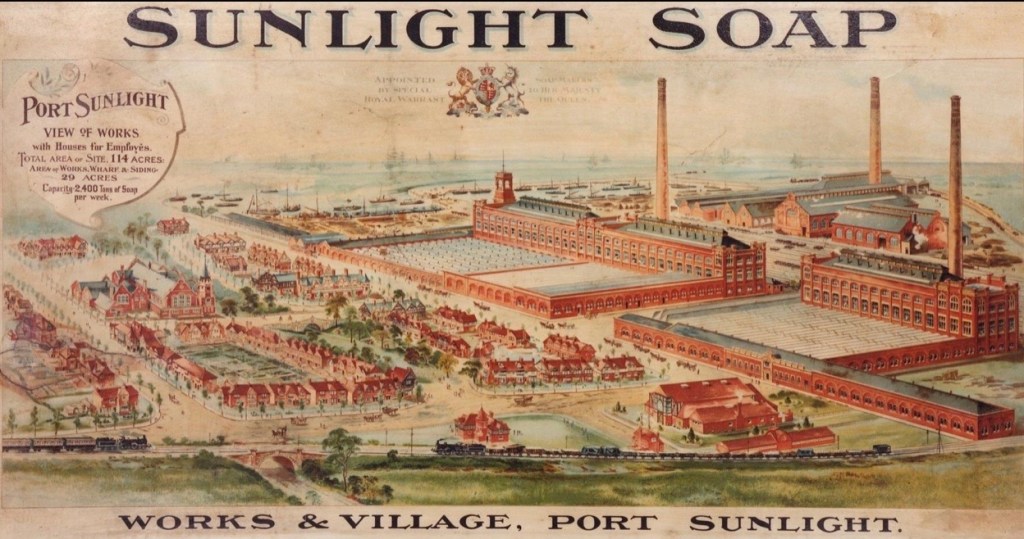
In Europe, the creation of more equitable and just societies is seen largely as a product of state or trade union action. However, Lizabeth Cohen argues, in ‘Making a New Deal: Industrial Workers in Chicago, 1919-1939’, that in the early twentieth century, a new entity emerged in the US, corporations which were highly productive and interested in social responsibility. They were motivated to redistribute (to an extent) the benefits of capitalism back to their labour force and the wider community. These corporations created a version of Welfare Capitalism, often called Industrial Paternalism. Altruism was a contributing factor behind these improvements, but companies were motivated by other factors. Higher incomes, better factory conditions, and improved housing led to higher productivity and higher retention. Furthermore, there was a belief that Industrial Paternalism would reduce industrial unrest and the risk of society fragmenting. An examination of the rationales for building company towns, the most visible form of Industrial Paternalism, reveals the different motivations. Garay highlights the altruistic rationale, at Gary, Indiana, the US Steel’s company town, which was built on the idea of a “benevolent landlord where both parties were mutually agreeable to both working and living arrangements”. The result was a town which provided “miners and their families with comfort and convenient access to schools, businesses, recreational facilities, and places of worship”. Nolan captures the idea of building productive communities in the film ‘Oppenheimer’ (2023), when the leader of the Manhattan Project bluntly states that the underlying philosophy for building Los Alamos, the home of the A-bomb and the people who built it: “We’ll need a school, stores, a church … If we don’t let scientists bring their families, we’ll never get the best”. Borges and Torres argue that company towns were built to create “better living conditions for workers to avoid conflicts, increase productivity, and boost profits”. In each case, organisations identified the benefits of sharing the benefits of productive labour with workforces, their families and their communities.
However, by the 1970’s, this form of Welfare Capitalism was facing challenges. The influential US economist Milton Friedman stated that the idea that corporations had a social responsibility was a ‘fundamentally subversive doctrine’ in a free society. He argued that a businessman who made decisions, “in accord with his ‘social responsibility’ reduce[s] returns to stockholders” and was in “effect imposing taxes, on the one hand, and deciding how the tax proceeds shall be spent, on the other”. This, in Friedman’s view, was problematic and undemocratic as it raised the businessman “to be simultaneously [a] legislator, executive and jurist” without a political mandate. As a result, he concluded “there is one and only one social responsibility of business—to use its resources and engage in activities designed to increase its profits …” This view, although embraced at the time, is flawed, because it underestimates the role of Corporate Boards to represent shareholders interests. Boards are a form of ‘representative democracy for shareholders’ that can legitimately give executives the authority act in social responsible ways including supporting Industrial Paternalism, a reality which directly undermines Friedman’s contention.
Nevertheless, Friedman’s work was influential, and when combined with Jensen’s thinking on corporate executive incentives, including the granting of stock options, contributed to the decline of Industrial Paternalism and the redistribution of wealth to shareholders and management. Outside a few companies (e.g. Dell), Industrial Paternalism today exists in a twilight zone of limited commitment, confined to minimal additions to employment packages (from subsidised cafeterias and gyms), promotional activities (from recruitment ads to mission statements which emphasise ‘having a purpose’) and token efforts (company charity days, food drives, donation matching). On occasion, it is factored in as ‘cost of doing business,’ for example, requirements to build social housing or new transportation hubs in order to receive planning permission for real estate developments. Ultimately, these programmes fail to meet the standard required to materially improve the lives of employees, their families and communities. As a result, we have a form of half-hearted paternalism which is ineffective and has turned people away from the concept altogether.
However, with the challenges of growing wealth inequality, labour’s reducing share of GNP and reduced employment opportunities for young people, trends increasingly magnified by the impact of AI, there is a need once again to debate the value of a return to new forms of Industrial Paternalism. In the next three years, boards and executives will increasingly face five questions:
- What are the productivity and distribution impacts of new technologies and AI – what will be the ratio between the creation of new jobs, the increased productivity of current workers and the loss of jobs?
- What are the responsibilities of corporations to shape and support future employment patterns?
- What is the range of opportunities for corporations to contribute to society, in particular by using their capabilities to improve social outcomes, e.g., supermarket chains playing a leading role in redesigning food systems?
- How do we create greater recognition of the value of combining commercial and social activities to improve social outcomes, and increase the openness to share ideas across corporations, charities and the state?
- How can we improve the understanding and measurement of corporations’ social contributions to reinforce their value in the public eye?
Boards and executives, by addressing these questions, have an opportunity to consider the needs of their shareholders, employees, and society. Notably, these questions are not counter to a corporation’s goal of growing shareholder value. Rather, they lead to a more balanced, measured, equitable approach to the distribution of wealth, which would improve the lives of employees, communities and contribute to long-term stability, growth in productivity and increased profitability.
 The Archive of Free Thinking
Leave a comment